
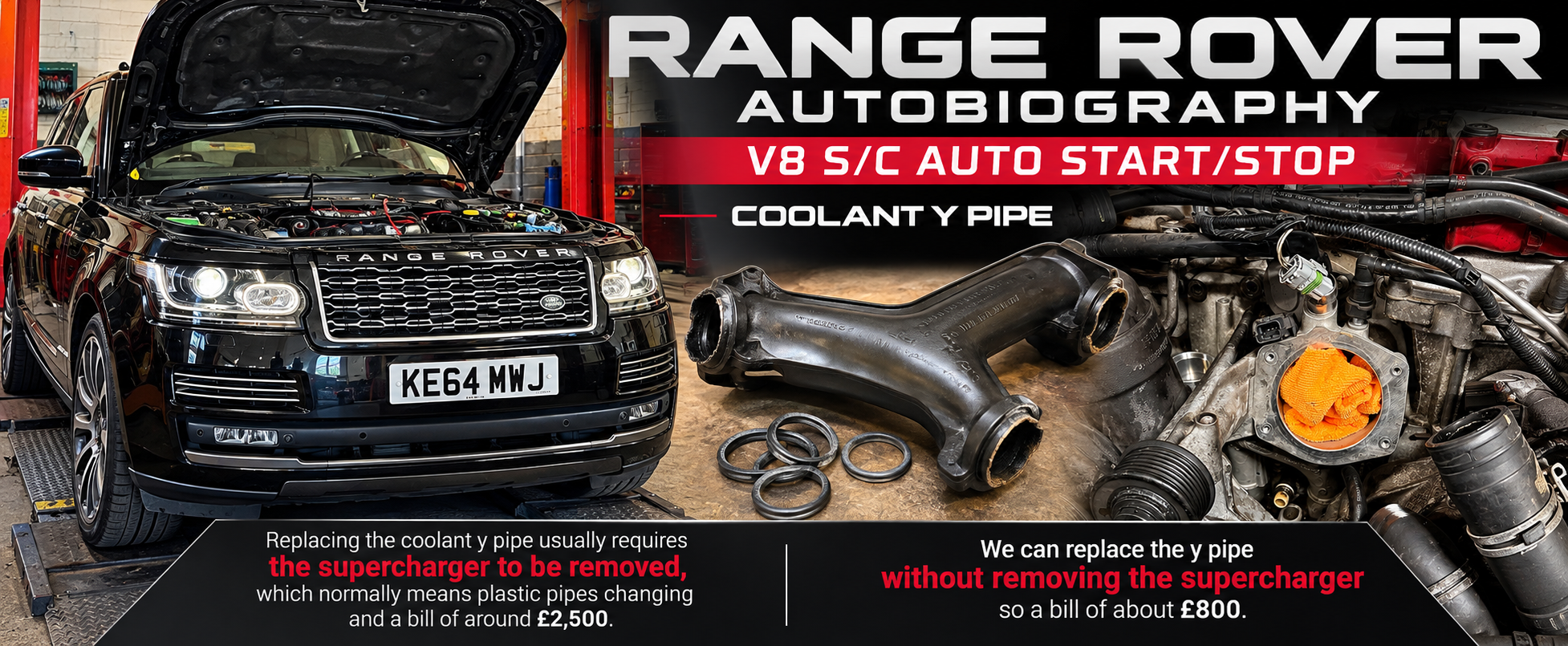
Inside the Workshop: Range Rover 5.0 Supercharged Coolant Y-Pipe Repair
Range Rover Autobiography • 5.0 V8 Supercharged • KE64 MWJ
Sometimes a relatively inexpensive component can turn into a very expensive repair simply because of where the manufacturer put it.
This 2014 Range Rover Autobiography 5.0 V8 Supercharged came into the workshop requiring attention to its coolant Y-pipe or Crososover Pipe
It is a problem worth taking seriously. Cooling-system pipe failures are widely reported by owners of supercharged Jaguar Land Rover engines, with particular concern surrounding plastic coolant components positioned around and beneath the supercharger. Owners have reported anything from gradual coolant loss to pipes splitting and causing rapid loss of coolant.
For this Range Rover, however, there was another important part of the story:
We were able to replace the Y-pipe without removing the supercharger.
Why is the coolant Y-pipe a problem?
The 5.0 V8 Supercharged engine operates with considerable heat packed into a relatively confined engine bay.
Parts of its cooling system use moulded plastic pipes and O-ring connections. After years of heating and cooling cycles, deterioration of the plastic and sealing arrangements can eventually result in leakage.
The location makes matters worse.
A leak isn't necessarily accompanied by a large puddle underneath the car. Coolant leaking into the hot area around the V of the engine can make the source considerably less obvious.
Owner reports describe crossover-pipe leakage being discovered despite vehicles apparently running normally, sometimes with little or no obvious coolant loss beforehand.
Don't ignore unexplained coolant loss
A coolant warning or unexplained reduction in coolant level on one of these engines deserves investigation.
Continually topping up the expansion tank without establishing where the coolant is going isn't a solution.
A small leak may remain manageable for some time, but a deteriorating plastic component can eventually fail much more seriously. Loss of sufficient coolant creates the possibility of overheating and potentially much more expensive engine damage.
That is why finding the cause before a pipe fails seriously is so important.
The £2,500 problem
The Y-pipe itself isn't what makes this potentially such an expensive job.
Access is the problem.
The conventional approach to reaching coolant components buried beneath the supercharger involves considerable dismantling and, for the Y-pipe in question, removal of the supercharger is commonly described as part of the repair procedure. Detailed owner repair documentation shows just how much has to be disconnected and removed to gain that access.
Once a workshop has dismantled the engine to that extent, it can also make sense to replace other ageing plastic cooling-system components while access is available.
The result is that what started as a leaking plastic pipe can develop into a repair bill in the region of £2,500.
Owner experiences illustrate the scale of these repairs, with substantial labour attributed specifically to removing the supercharger to replace coolant crossover pipes.
We found another way
With KE64 MWJ, we approached the job differently.
Rather than automatically following the route of removing the supercharger, we worked out how to obtain the access required to remove and replace the coolant Y-pipe with the supercharger remaining in position.
The photographs from the job show the access achieved and the original Y-pipe removed from the engine.
Avoiding supercharger removal considerably reduced the amount of dismantling required and therefore the labour involved.
The cost of this particular repair was approximately £800 rather than the circa £2,500 that a more extensive strip-down can become.
That is a substantial difference for essentially the same objective: replacing the failed Y-pipe and returning the cooling system to correct operation.
Does that mean every one costs £800?
No — and that's important.
Every vehicle is assessed individually.
The approximately £800 figure relates to the repair carried out on this particular Range Rover. Once work begins, inspection may identify other components that require replacement.
These could include items such as:
- auxiliary drive belt
- water pump
- hoses or connections
- other cooling-system components showing deterioration
If additional parts or work are required, they will naturally increase the final cost.
However, these aren't additional costs caused by our method of replacing the Y-pipe.
If a water pump is leaking, a belt is deteriorated or another component requires replacement, that work would be necessary whichever method was used to gain access to the Y-pipe.
In fact, owner discussions of these engines frequently mention water pumps and additional cooling components being discovered or replaced during crossover-pipe work.
So we don't advertise this as a fixed-price £800 repair without first seeing the vehicle.
Repair what actually needs repairing
This job illustrates something that is fundamental to the way we work.
A manufacturer's established dismantling procedure is obviously one way of completing a repair, but experience and engineering knowledge can sometimes provide another.
That doesn't mean taking shortcuts.
It means understanding what actually needs to be removed to complete the repair correctly rather than automatically dismantling everything simply because that is the conventional route.
On this Range Rover, leaving the supercharger in place eliminated a significant amount of unnecessary work.
And that translated directly into a considerably smaller bill for the customer.
Own a 5.0 Supercharged Range Rover?
If your Range Rover is losing coolant, displaying a low-coolant warning, producing a coolant smell or showing evidence of leakage, it is worth having the cause properly diagnosed.
Given the potential consequences of significant coolant loss, we wouldn't recommend simply topping it up and continuing to use the vehicle without establishing where the coolant is going.
And if the problem turns out to be the Y-pipe, removing the supercharger may not necessarily be the only option.
Vehicle featured
2014 Range Rover Autobiography
5.0 V8 Supercharged Auto Start/Stop
Registration: KE64 MWJ
Coolant Y-pipe replaced without removing the supercharger.
Typical extensive repair: around £2,500
This vehicle: approximately £800
Additional parts or repairs identified during the work are additional. Every vehicle is inspected and quoted individually.
Inside the Workshop at TuningWorx
Every week our workshop sees a wide range of interesting vehicles, electronic systems and engineering problems.
Inside the Workshop is where we'll document some of that work.
Rather than filling this section with generic automotive articles, we'll use actual jobs from the workshop — showing the vehicle, the problem, what we found and, where appropriate, how we solved it.
Our work covers far more than conventional ECU remapping. Depending on what comes through the door, you'll find examples of:
- ECU and TCU programming
- ECU unlocking and recovery
- Bespoke engine calibration
- Gearbox and transmission calibration
- Rolling-road development
- Injector testing and cleaning
- Electronic fault diagnosis and repair
- Classic-car tuning
- Rover V8 and Lucas 14CUX development
- Specialist and unusual vehicles
We'll also publish genuine rolling-road results and technical information where it is useful.
Real Vehicles. Real Workshop Work.
Much of the equipment and knowledge used at TuningWorx has been developed through years of actually diagnosing, repairing, programming and tuning vehicles.
This section gives us somewhere to show that work rather than simply telling you what we can do.
We'll be adding new workshop jobs regularly, together with selected work from the Turner Performance archive.
Check back regularly to see what's been Inside the Workshop.