

Garrett Performance Turbos • Turbo Selection • Bespoke ECU Calibration • Rolling Road Development
Choosing the Correct Turbocharger
A turbocharger upgrade should start with the required result, not simply with the largest turbocharger that can physically be fitted.
TuningWorx can help customers select an appropriate turbocharger based on the engine specification, intended use and required performance.
A road car requiring strong low and mid-range response may need a very different turbocharger from an engine being developed primarily for maximum power.
Before recommending a turbocharger, we consider factors including:
- Engine capacity
- Engine specification
- Current modifications
- Required power and torque
- Maximum engine speed
- Intended boost pressure
- Fuel being used
- Road, track or competition use
- Desired response and spool characteristics
- Fuel-system capacity
- Supporting engine modifications
The objective is to select a turbocharger which operates effectively across the part of its operating range that the engine will actually use.
Garrett Performance Turbochargers
We support Garrett performance turbocharger upgrades because Garrett provides the engineering information required to properly assess and calibrate the installation.
Rather than relying solely on an advertised horsepower figure, Garrett publishes technical information that allows the compressor's operating characteristics to be examined.
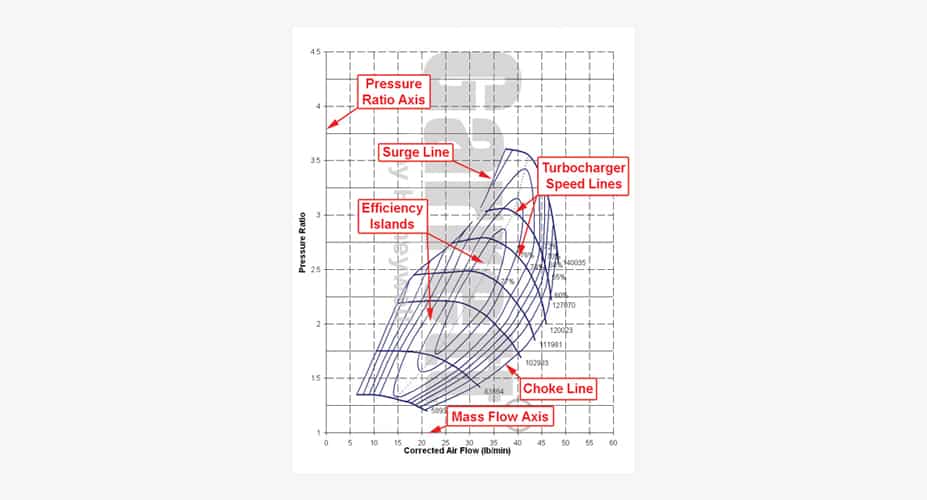
This includes compressor maps.
A compressor map describes characteristics including:
- Air mass flow
- Pressure ratio
- Compressor efficiency
- Surge limit
- Choke limit
- Turbocharger speed
These allow the engine's expected operating points to be considered against the capabilities of the compressor. Garrett Motion
Why Compressor Maps Matter
Two turbochargers capable of producing the same peak boost pressure are not necessarily equally suitable for an engine.
Boost pressure alone does not describe how much air the compressor can supply, how efficiently it is operating or how close it is to its operating limits.
A compressor map allows calculated engine airflow and pressure ratio to be plotted against the compressor's operating range.
This helps determine whether the proposed turbocharger is operating in an appropriate efficiency region and whether the required operating points are approaching surge, choke or excessive turbo speed. Garrett specifically warns that operation beyond the choke region is associated with rapidly increasing turbo speed and the likelihood of overspeed. Garrett Motion
This information is extremely useful when selecting a turbocharger before the vehicle is built.
We Can Help Specify the Turbo
You do not necessarily need to arrive with a turbocharger already purchased.
If you're planning an engine build or performance upgrade, talk to us about the result you want to achieve.
We can use the engine specification and required performance to help determine the airflow and pressure requirements and identify suitable Garrett turbocharger options.
Garrett itself recommends beginning with the application's intended use and horsepower target, then considering engine displacement and plotting calculated mass flow and pressure ratio against compressor maps. Garrett also notes the basic compromise: a turbo that is too large can respond slowly, while one that is too small may be unable to achieve the required power. Garrett Motion
Garrett also provides its Boost Adviser tool to help identify candidate turbochargers from parameters including power target and engine displacement. Garrett Motion
Garrett's detailed technical guide to compressor maps and turbocharger selection is available here:
Garrett Motion – Turbo Compressor Map Expert Guide
Why We Don't Automatically Support Unknown Hybrid Turbos
The term “hybrid turbo” covers an enormous range of products.
Some are properly engineered and documented. Others may consist of modified compressor and turbine components installed into an original housing with very little technical information supplied about the resulting turbocharger.
The problem for the calibrator is simple:
What is the turbocharger actually capable of?
Without reliable engineering data, we may not know its:
- Compressor operating range
- Airflow capability
- Efficiency
- Surge characteristics
- Choke limit
- Safe turbo speed
- Turbine characteristics
- Intended boost range
A claimed horsepower figure doesn't provide this information.
We are therefore generally unwilling to develop a bespoke calibration around an unknown turbocharger where adequate technical information isn't available.
That isn't because a hybrid turbocharger cannot work. It is because we don't believe in guessing at the operating limits of a component while calibrating an engine around it.
Documented Turbo Upgrades
Where a turbocharger manufacturer can provide meaningful technical information about the product, we can assess the application properly.
In addition to Garrett performance products, we can work with appropriate Turbo Dynamics applications and other properly specified turbocharger upgrades where sufficient technical information is available.
Each application is considered individually.
Supporting Modifications
A larger turbocharger does not create a complete performance package by itself.
Depending on the required power level, supporting modifications may include:
- Fuel injectors
- High-pressure fuel system
- Low-pressure fuel supply
- Intercooler
- Intake system
- Exhaust system
- Boost-control hardware
- Engine internals
- Clutch or transmission
- Cooling system
These need to be considered before calibration begins.
Garrett's own turbo-matching guidance similarly treats turbo selection as part of the complete system and identifies fuel-system requirements and other engine components as part of planning around a horsepower target. Garrett Motion
Fuel System Capacity
More air requires the appropriate quantity of fuel.
Before attempting to achieve a particular power target, the injectors and fuel system need sufficient capacity to supply the engine safely.
Trying to compensate in software for injectors or pumps which have reached their physical limits is not an acceptable solution.
Where appropriate, TuningWorx can test petrol injectors and assess their flow and balance before calibration.
Bespoke ECU Calibration
A significant turbocharger change requires appropriate ECU calibration.
The calibration needs to consider considerably more than simply increasing a boost target.
Depending on the engine management system and application, development may involve:
- Boost control
- Wastegate control
- Load calculation
- Torque modelling
- Fuel delivery
- Lambda targets
- Ignition timing
- Airflow modelling
- Temperature protection
- Engine torque management
- Transmission interaction
The exact strategy depends on the ECU and vehicle.
Rolling Road Development
Modified turbocharged engines are particularly suited to controlled development on our in-house rolling road.
The rolling road allows the engine to be operated under controlled load while we measure and log its behaviour.
Calibration changes can then be assessed using actual data rather than assumptions.
Where appropriate, this can include monitoring:
- Power and torque
- Boost pressure
- Air/fuel ratio
- Fuel pressure
- Ignition behaviour
- Intake temperature
- Engine torque
- Knock control
- Other ECU parameters relevant to the application
The final objective is not simply the highest number produced during one dyno run.
We are looking for a calibration which produces the required performance while operating the engine and turbocharger appropriately.
Already Bought a Turbo?
If you've already purchased a turbocharger, send us the manufacturer and exact part number before booking the vehicle for calibration.
For a Garrett turbocharger, the exact model and specification allow us to examine the manufacturer's technical data and compressor information.
For other upgraded or hybrid turbochargers, we may ask for the manufacturer's technical specifications before agreeing to calibrate the vehicle.
If adequate information isn't available, we may recommend a different turbocharger rather than attempting to calibrate around an unknown component.
Planning a Turbo Upgrade?
If you haven't bought the turbocharger yet, that's often the best time to contact us.
Tell us:
- What vehicle and engine you have
- Current engine specification
- Existing modifications
- Fuel being used
- Intended use
- Current power where known
- The power and driving characteristics you want to achieve
We can then help assess the requirements and, where appropriate, recommend a suitable Garrett turbocharger before you spend money on the wrong hardware.