
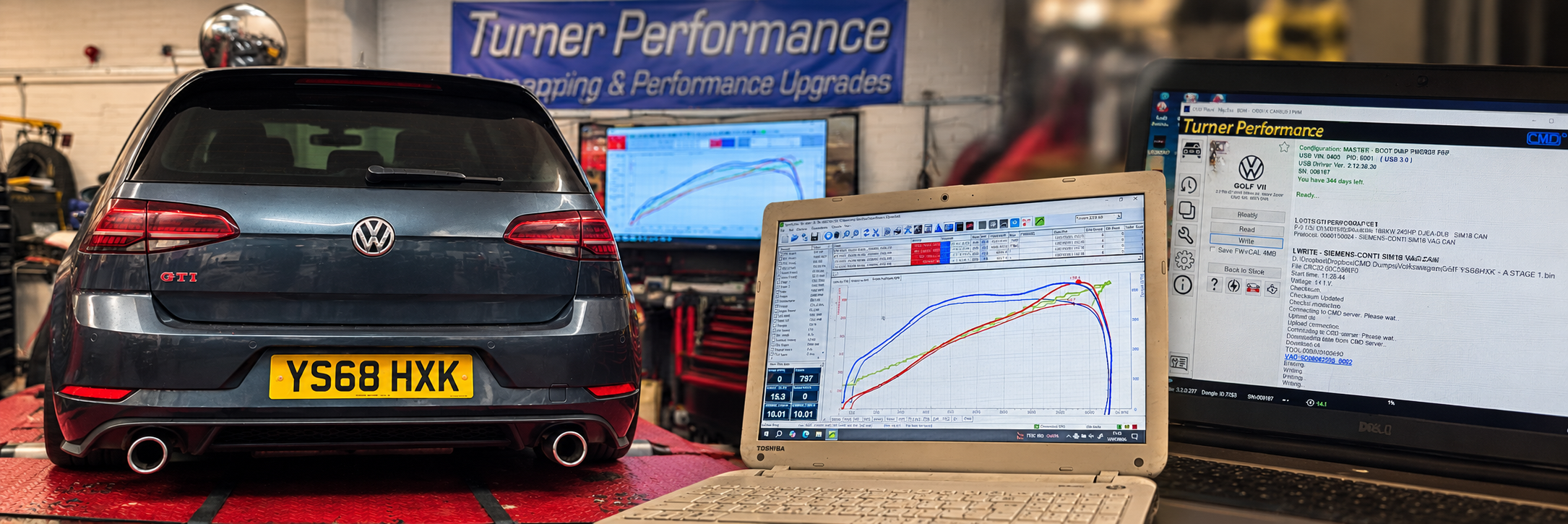
Performance Diagnostics
Engine Performance • Data Analysis • Rolling Road Diagnosis
Find the Problem Before Changing the Calibration
When an engine isn't performing correctly, changing the ECU calibration isn't the place to start.
Poor performance can result from mechanical, electrical, fuelling, ignition, boost-control or engine-management problems. A fault code may provide useful information, but it doesn't necessarily identify the component responsible for the fault.
At TuningWorx, performance diagnosis is based on testing and measurement rather than replacing parts until the problem disappears.
This is particularly important before engine calibration. A remap cannot repair a mechanical or electronic fault.
Performance Problems We Investigate
Performance faults don't always produce a warning light or diagnostic trouble code.
We investigate problems including:
- Loss of power
- Misfires
- Hesitation
- Flat spots
- Poor throttle response
- Boost-control problems
- Difficult starting
- Poor idle quality
- Excessive fuel consumption
- Fuel delivery problems
- Ignition problems
- Intermittent faults
- Performance problems occurring only under load
The testing required depends on the symptoms and the vehicle.
More Than Reading Fault Codes
Diagnostic trouble codes are a starting point, not a diagnosis.
A fault relating to a sensor, mixture, misfire or boost system doesn't automatically mean that the named component is defective.
The cause may be elsewhere in the system.
Depending on the problem, diagnosis can involve live ECU data, electrical measurements, oscilloscope testing, fuel-system testing, mechanical tests and operation of the vehicle under load.
The objective is to establish what is actually happening and why.
Manufacturer-Level Diagnostics
TuningWorx has access to professional and manufacturer-level diagnostic equipment for a wide range of vehicles.
Manufacturer diagnostic systems can provide functions and information that aren't necessarily available through generic diagnostic equipment, including detailed live data, system tests, adaptations and control-unit information.
This allows the electronic systems to be investigated alongside the mechanical operation of the engine.
PicoScope Oscilloscope Diagnosis
An automotive oscilloscope allows us to see electrical signals that a conventional multimeter or diagnostic scanner cannot show.
Depending on the fault, PicoScope testing can be used to examine:
- Crankshaft and camshaft signals
- Injector operation
- Ignition signals
- Sensor outputs
- Actuator control
- Power supplies and grounds
- Communication signals
- Relative compression
Waveform analysis can be particularly valuable when investigating intermittent or high-speed electrical events.
Engine Condition Testing
Before investigating calibration as the cause of poor performance, the basic condition of the engine may need to be established.
Depending on the symptoms, testing can include:
- Compression testing
- Relative compression testing
- Leak-down testing
- Fuel-pressure testing
- Ignition-system assessment
- Intake and vacuum testing
- Injector assessment
This helps separate a mechanical or fuel-system problem from an electronic or calibration issue.
Diagnostics Under Load
Some of the most difficult performance problems only occur when the engine is working hard.
An engine may idle perfectly in the workshop but misfire, lose fuel pressure, suffer ignition breakdown or fail to control boost correctly under load.
Our in-house rolling road provides a controlled environment in which suitable faults can be reproduced while vehicle and engine data are monitored.
This can be particularly useful for investigating problems that cannot be reproduced during stationary workshop testing.
Air/Fuel Ratio Measurement
Wideband oxygen measurement allows us to independently monitor mixture behaviour while the engine is operating.
This is particularly valuable when investigating petrol engine performance.
It can help identify conditions involving fuel delivery, mixture control or calibration that may not be obvious from diagnostic trouble codes alone.
Data Logging and Analysis
Modern engine-management systems provide considerable information about what the ECU is seeing and how it is responding.
Where supported, data logging can allow us to examine parameters such as:
- Engine load
- Airflow
- Fuel pressure
- Boost pressure
- Lambda control
- Ignition correction
- Throttle position
- Temperatures
- Requested and actual values
The useful parameters vary between engine-management systems, so diagnosis is based on the particular vehicle rather than a fixed checklist.
Modified Vehicle Diagnostics
Modified vehicles introduce another level of complexity.
A problem may result from the calibration, but it can equally be caused by an incorrectly specified component, installation problem, inadequate fuel supply, boost leak, sensor limitation or incompatibility between modifications.
We therefore consider the complete engine specification rather than assuming that software is responsible.
Before ECU Remapping
A vehicle presented for tuning needs to be operating correctly before meaningful calibration work can begin.
Where our initial assessment identifies a problem, we may recommend diagnosis or repair before continuing with the remap.
This protects both the engine and the quality of the final calibration.
Specialist Services
Some performance problems require testing outside the scope of normal vehicle diagnosis.
TuningWorx also provides dedicated:
Petrol Injector Testing & Cleaning — including flow testing, spray-pattern assessment, cleaning and before/after reporting.
ECU Testing & Repair — component-level electronic diagnosis and repair for suitable control units.
These are separate specialist services rather than automatically forming part of a performance diagnostic session.
Diagnosis Based on Evidence
Good diagnosis isn't about performing every possible test.
It is about selecting the appropriate tests, interpreting the results correctly and using each result to determine the next step.
Our approach is straightforward:
Test. Measure. Understand. Then repair or calibrate.