
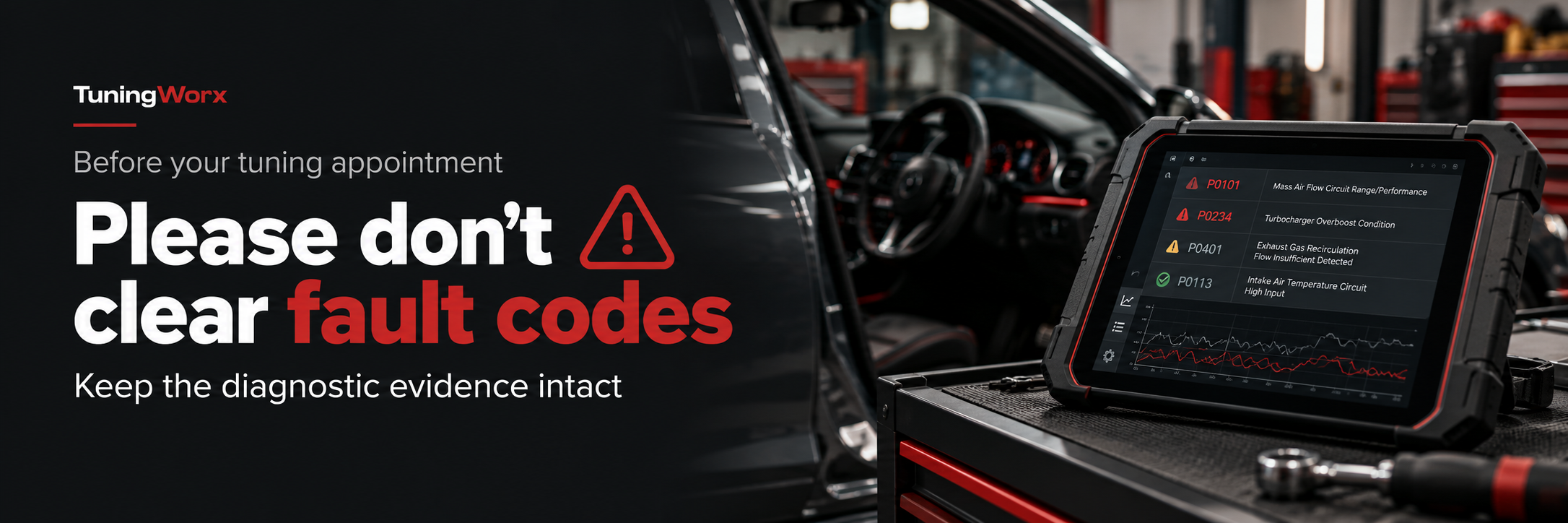
 Before your tuning appointment: please don’t clear fault codes
Whether your code reader finds faults or reports “no codes found”, please leave the fault memory intact before your appointment at TuningWorx.
Stored fault codes and the information recorded alongside them help us understand how your vehicle has been operating. Clearing that information can remove valuable evidence before we have had the opportunity to assess it.
Fault codes cleared within the last 14 days
Our professional diagnostic equipment can identify when fault codes were last cleared on vehicles that record this information.
If fault codes have been cleared within the previous 14 days, we will not carry out tuning.
This applies whether the codes were cleared by you or another workshop, including after repairs. If anything has recently been cleared, please tell us before travelling so we can rearrange your tuning appointment.
The 14-day period is a minimum requirement. It does not, by itself, establish that the vehicle is ready for tuning; that decision also depends on our pre-tuning assessment.
Your code reader may not show the whole picture
A basic generic EOBD reader can be useful, but its coverage is generally focused on standardised emissions-related engine diagnostics. It may not access manufacturer-specific faults or the information stored in other control modules.
“No codes found” does not mean there are no faults. It means the reader has found none within its coverage.
A reader may also be able to clear diagnostic information that it cannot fully display. Pressing “clear codes”, even when nothing appears on its screen, can therefore delete evidence that our professional diagnostic equipment could have retrieved.
Some mechanical and performance problems do not generate fault codes at all, so a clear scan alone does not establish that a vehicle is ready for tuning.
Clearing codes can permanently remove useful evidence
Depending on the vehicle and the fault, diagnostic records can include a snapshot of the operating conditions when the problem was detected. This is commonly called freeze-frame data.
Engine speed, temperature, load and other recorded values can help us establish the circumstances in which a fault occurred. That information can be particularly valuable when a problem is intermittent or difficult to reproduce.
Clearing the fault memory can erase both the code and its associated freeze-frame data. Once that original record has been deleted, it cannot be recovered.
If the fault occurs again, the vehicle may capture a new record. That does not restore the evidence from the earlier event, and the same operating conditions may not occur again during our checks.
Turning off a warning light by clearing a code does not repair the underlying problem.
Resets can affect our pre-tuning checks
Clearing codes can also reset emissions readiness monitors. Depending on the vehicle and the diagnostic procedure, learned values such as fuel adaptations may also be affected.
These learned values can help us understand how the engine has been compensating during normal operation. Resetting them before an appointment can remove useful context, and suitable driving conditions may be needed before that information becomes meaningful again.
If codes or adaptations have already been reset, tell us what was done, when it was done and whether any repairs were carried out.
A stored fault does not automatically rule out tuning
We do not expect every vehicle to arrive with a completely clear fault memory. Assessing the vehicle is one of the reasons we carry out pre-tuning health checks.
What matters is the nature of the fault, whether it is current and whether it affects the proposed work. An emissions-related fault can still be relevant to engine operation and should be left for us to assess.
We would much rather see the available evidence, understand the problem and discuss it with you. If something needs attention before tuning, we can explain why and agree on the next step.
Before you arrive
- Leave fault codes, fault memory and adaptations intact, even if your reader reports no faults.
- Tell us about warning lights, intermittent symptoms and recent repairs.
- Bring any previous diagnostic reports or screenshots.
- Let us know before travelling if codes have been cleared within the last 14 days.
- Contact us if you are unsure whether your vehicle is ready for its appointment.
Please bring your vehicle with its diagnostic history intact. Preserving the evidence helps us make an informed decision before tuning begins.